More than 100 attendees filled the room at the Burke Museum of Natural History and Culture on Friday, Oct. 2, for a Society + Technology at UW symposium addressing the power of public research.
As the sun set outside the museum’s glass-walled Cascade Room, scholars from across all three University of Washington campuses and the School of Medicine shared from their array of research areas with an audience that included students, university staff and faculty, and curious members of the public.
Andrew Connolly gave the keynote. He is UW’s Associate Vice Provost for Data Science and a professor in the Department of Astronomy. Connolly spoke about Einstein’s theory of general relativity, and the transformational field equations of gravity he published in 1915. “Einstein’s ideas, and the whole process of how he came to those ideas and built this framework, was profoundly human,” Connolly said, noting that the famous scientist built upon the work of other researchers and developed ideas in concert with them.
Technology is changing, but the way it is taught isn’t changing as quickly, Connolly said.
Guidance and education must develop as new tools develop, and universities like the University of Washington are well-positioned to provide the breadth, depth of knowledge and rigorous curriculum that will develop students’ critical thinking skills and lead to research breakthroughs.
A dozen lightning talks followed the keynote. Each scholar had one key term on which to focus, and they worked to draw connections between topics. Keywords included power, tradition, agency, war and authorship. The speakers represented a vast constellation of departments, including Nursing, Communication, Human Centered Design and Engineering, Philosophy, French & Italian Studies, Social Work, Bioethics and Humanities, International Studies and Urban Studies.
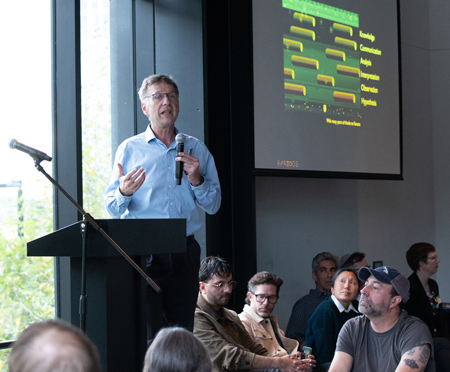
The free event was more open, more elevated and more cross-disciplinary than most academic events — and that was part of the point.
“Scholarship itself is a human technology,” said Monika Sengul-Jones, who organized the event. As the director of strategy and operations for the Society + Technology at UW initiative, she regularly convenes gatherings with a focus on increasing connection, empathy and collaboration. “Researchers aren’t only developing tools for understanding the world,” they’re also working together to improve it, she said.
Sengul-Jones said that research collaborations have already developed from the connections she’s made between UW researchers working in different fields who had the opportunity to meet and learn about one another’s work through Society + Technology at UW events.
“Some of them didn't know each other already. So someone like Nassim Parvin in the iSchool is in conversation with Agnieszka Jeżyk, who's in Slavic Studies. They don't typically interact,” Sengul-Jones said, “just because of the way that institutions are organized. So I was trying to make these connections early on.”
In her lightning talk, Parvin spoke about the concept of diversity. “Diversity shapes the horizon of possibility, and within it, our technologies,” said the professor and associate dean for Inclusion, Diversity, Equity, Access & Sovereignty (IDEAS) at the Information School. “I find myself in the ironic position of defending a term I find wholly inadequate,” she said, and countered the claim that diversity dilutes excellence.
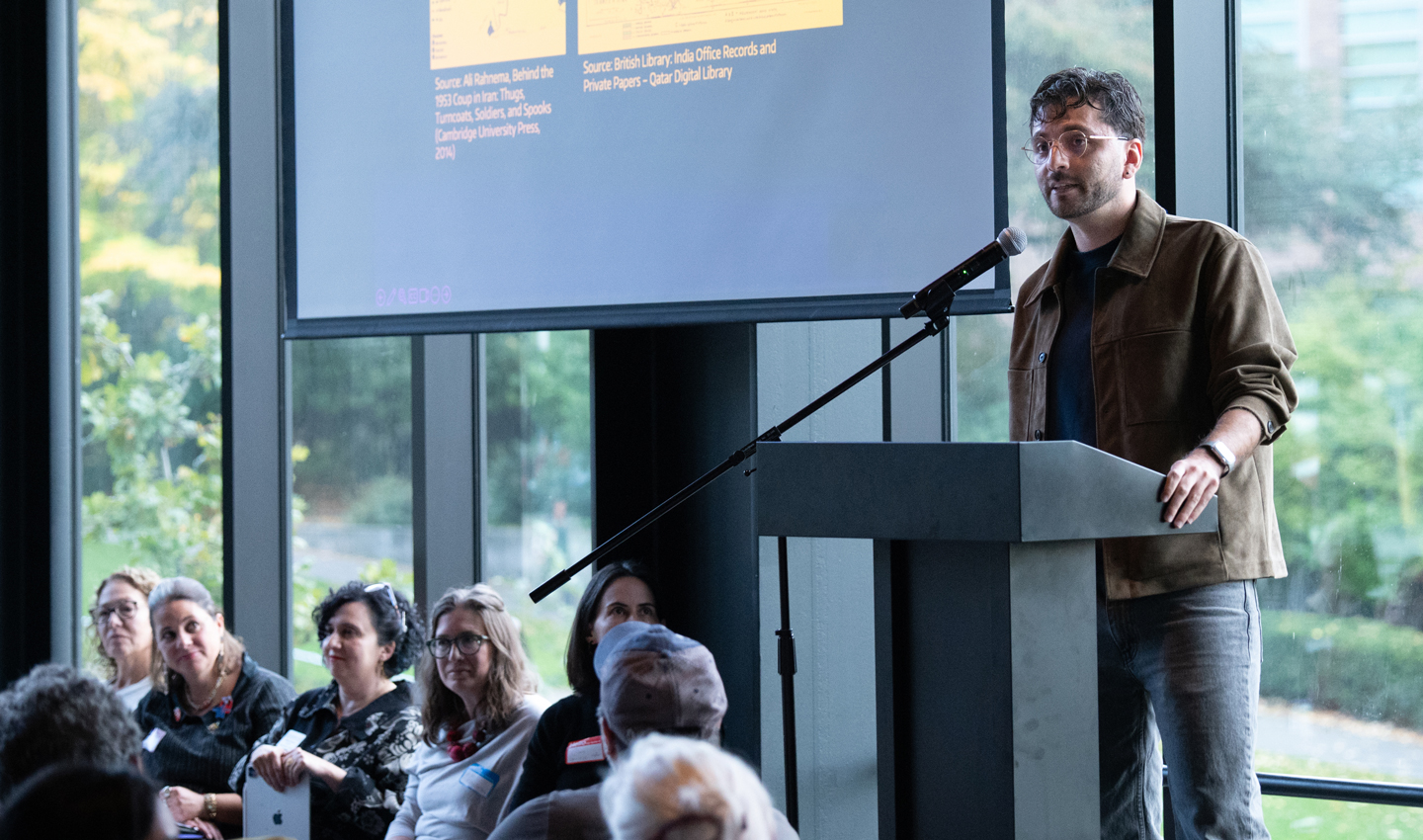
Mert Can Bayar (pictured at top), UW Bothell faculty and Center for an Informed Public (CIP) researcher, was invited to speak about conspiracy. He said that in terms of impact, “conspiracies are real events,” adding that broader conditions affect how conspiracies spread. “When democracy grows thin, conspiracies grow thick,” Bayar said, citing recent CIP research.
The event was the second major convening of the Society + Technology at UW initiative, which is led by Sengul-Jones and faculty co-founders Ryan Calo and Leah Ceccarelli. The first convening took place in January 2025.
“It’s great to engage with so many scholars from different disciplines at the same event,” Parvin said. “It’s so well thought-out.”
Sponsored by legal firm Schwabe, AI@UW, the UW Information School, the Center for an Informed Public and the Tech Policy Lab, with support for the initiative from the Office of the Provost, the event included thematic dinner tables after the lighting talks. At the table focused on care, a physician and researcher led a discussion that included an EMT, an international human rights agency leader, and a legal student, all discussing ethics and impacts of technology on human connection.
The Information School, with its interdisciplinary focus, was well-represented at the symposium.
Additional iSchool faculty and affiliates who presented include Aylin Caliskan, associate professor and the lead convener for the discussion on expertise; Marika Cifor, associate professor and the lead convener for the discussion on agency; Carole Lee, Philosophy professor and adjunct professor in the iSchool, who spoke about expertise; and Brandon Locke, CALMA program manager and the lead convener for the discussion on openness. Belén Saldías, Pelle Tracey and other iSchool faculty members also participated in the symposium.
Informatics students and Tech Policy Lab interns Raani Nigam and Ruth Karen Nakigozi were among the team who managed event logistics under Sengul-Jones’ direction. Holly Wescott and Ginevra Deianni provided ASL interpretation for the event, and Eileen Horst captioned the talks live for participants, facilitating shared understanding.
Alex Bolton, executive director of the Tech Policy Lab, said, “I think tonight is a really good example of the importance of relationships and relational work that happens on campus. To break down the siloes of different disciplines, there has to be that trust built between each other. Getting together in person and being able to see the community come together is so vital for that work.”
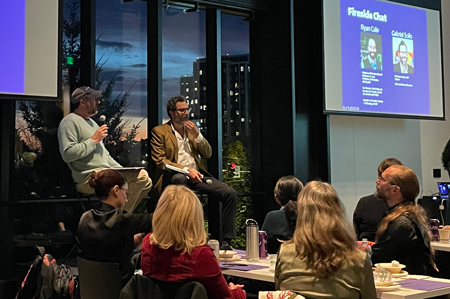
Ryan Calo, a professor in the iSchool and the School of Law, and Gabriel Solis, Dean of the Arts division and professor of music, closed out the evening with a fireside chat.
Concerns and interest in AI were present, but not foregrounded, in the conversations.
Audience questions raised concerns about “cognitive offloading,” in which people may lose vital critical skills when they designate tasks to be completed by AI workflows.
“It’s about the human context and the technology,” Calo said. He spoke about normativity, pragmatism and the law.
Calo and Solis expressed pride in working for a leading public university, to a full round of applause. Solis said it’s important for faculty to learn from their students as well as providing guidance, and to find out about how younger generations are processing technological changes.
Anna Khotsanyan attended the event and shared her experience as a younger person working in the AI field with the audience during the fireside chat’s question and answer session. She compared the passing of the torch during the Olympic Games to the innovators of her generation, who are coming of age in a tumultuous technological landscape.
Solis noted that most major changes don’t happen in isolation, and connected the formation of hip-hop with the creation of new technology. “Grandmaster Flash also had the Furious Five, and his parents’ record collection,” he said, noting the importance of working with others. “There is something really important about convening in this way.”
“I will always bet long on people. The end,” Solis said.