The world of artificial intelligence is growing and evolving every day. AI is so new, and so complex, that it’s hard even for experts to understand the benefits and risks it poses.
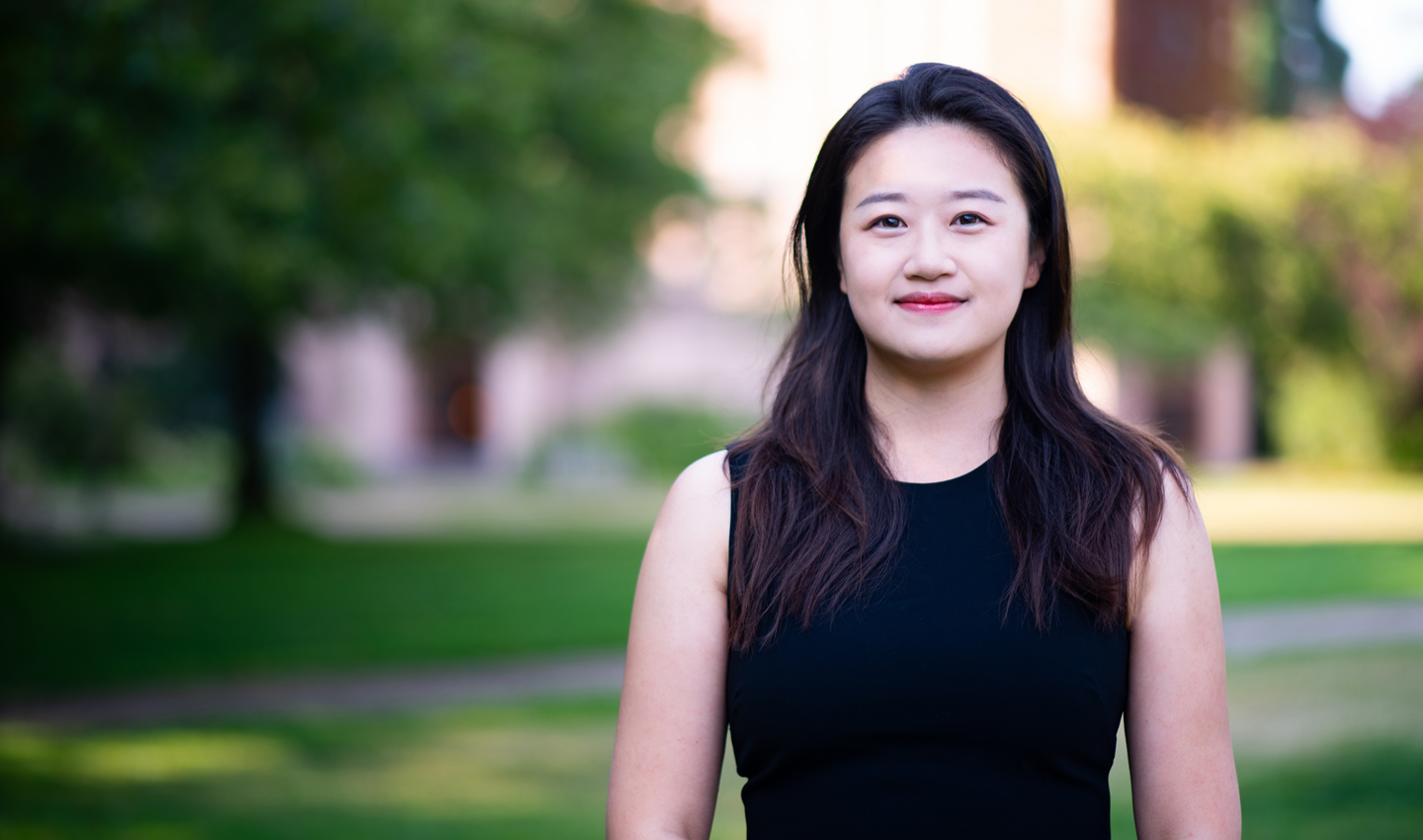
Yaman Yu, who recently joined the Information School as a tenure-track assistant professor, wants to broaden people’s understanding of AI and how at-risk users, in particular youth, could be protected and empowered in their interactions with it.
Yu comes to the University of Washington from the School of Information Sciences at the University of Illinois Urbana-Champaign, where she earned her Ph.D. Her research has focused on keeping youth and other at-risk users safe online.
“Teens have often been among the earliest adopters of emerging technologies, and today AI is becoming an increasingly important part of that landscape,” Yu said. “There are risks to AI that are unique to youth populations. Even adults are not clear how good or how bad using AI is, let alone teens and young adults.”
Yu has a background in privacy and security. She has worked with at-risk users, including people with neurological impairments and those with low or no vision. She tries to understand the challenges those people have using security methods, and how to help mitigate those risks.
Her interest in better understanding how youth interact with AI started when she presented a workshop on AI safety at a high school. A participant told her that some students were using AI as a virtual girlfriend or boyfriend.
“At the time, that was very shocking to me,” she said. “The school even had an AI dating club.”
That experience prompted her to learn more. Yu’s research since then has focused on understanding how teens and young adults interact with AI, as well as working toward guardrails to make AI safer.
As part of that, she studied data from teens who voluntarily shared their interactions with AI. It was one of the first studies of its kind to use real-world data. She has also worked on guardrail models and prototypes for tools that, while protecting a teen’s privacy, would let their parents know of serious concerns from conversations with AI. Based on her research, she’s also helped develop youth safety benchmarks that can guide companies in their AI development.
“What teens experience with AI can be very different from what adults experience,” Yu said. “It’s not necessarily that they know less about technology. They are encountering these systems at a time when they are still developing their sense of identity, relationships, judgment and independence. AI can become part of that process, whether as a source of information, advice or even companionship. That means we need to think about not only whether AI is safe in general, but what it means for someone who is still growing up.”
Her work has drawn attention from companies including Google and Meta, earned her several awards, and been reported on in national media, including the New York Times.
“Yaman has impressed me over and over as someone who is proactive,” said Professor Yang Wang, her advisor at the University of Illinois. “She is a thinker, but she is also a doer. She’s not only someone who can do good research, but also someone who truly cares about the populations that she works with, which is very important when working with vulnerable groups. She genuinely cares about how she could benefit their lives.”
The Information School’s commitment to using information and technology to improve people’s lives was a major reason Yu was drawn to the position. She was especially excited by the school’s interdisciplinary approach and its openness to thinking broadly about how meaningful change happens. Rather than viewing technology as a solution on its own, the Information School brings together technological innovation with an understanding of people, communities, institutions and social systems. Yu sees this balanced perspective as essential to designing solutions that are not only innovative, but also responsible, sustainable and grounded in the needs of society.
Yu will teach courses on Human-Centered AI Safety and Information Assurance and Cybersecurity.
“I love teaching and I love the moment when I am learning from my students as well,” she said.
While her focus is on youth and AI, she emphasizes that it’s not her only area of study; she’s interested in understanding how to protect all vulnerable populations.
“She’s a good teacher and good, dynamic speaker,” Wang said. “And she’s a good mentor of students with different levels of experience and different academic backgrounds.”
Yu will be recruiting Ph.D. students for fall 2027 and is interested in connecting with anyone interested in topics related to AI safety and protecting vulnerable populations.
“The most exciting part of this work will be if we can make real changes in AI safety for teens and young adults,” Yu said. “If we can push changes and make impacts that give us a safer AI environment for the next generation, I will be super excited.”