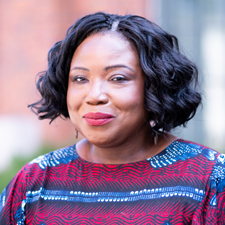
 Tracie D. Hall’s career has taken several turns since she earned her Master of Library and Information Science in 2000, most recently including a two-year appointment as the Distinguished Practitioner in Residence at the Information School. Now, she has started her next chapter.
Hall has begun her new position as the Executive Director of the Historically Black Colleges and Universities (HBCU) Library Alliance. The Library Alliance works to nurture library leadership and preserve historic collections within these academic institutions. HBCUs graduate a significant number of Black students and are a primary pipeline to graduate education and professional degrees for Black students.
However, despite the critical role they play in producing a sizable number of degree-holders, these institutions often lack commensurate funding. “The majority of HBCU students are the first generation in their families to go to college,” Hall explained. “To produce the number of national leaders that HBCUs have: Martin Luther King Jr., Oprah Winfrey, Kamala Harris, Stacey Abrams, etc., with a fraction of the budgets that other schools have, means that they are constantly punching above their weight.”
“To have this opportunity to champion HBCU libraries, to support them, to raise their visibility and to expand their capacity is just really a dream,” Hall said. “It is such an incredible thing to be able to do, in my professional career and at this moment in our nation’s history.”
While her residency has ended, Hall will still teach part-time at the iSchool, offering a couple of classes a year. Hall spoke positively about her time here. “We have such a brilliant and committed cohort of educators,” she said. “To have the kind of support and camaraderie I have experienced, and to see the deep investment in students coming out of the Information School daily, as a full-time faculty member, is something that I will miss.”
She described her hallway conversations with other faculty, where a brief “hello” would turn into deep discussions on classroom impact and how to better support student learning.
Yet, the impact Hall has left on the iSchool goes much deeper than her classroom instruction.
The Center for Advances in Libraries, Museums, and Archives (CALMA) was launched around the same time Hall began her faculty position. Hall received CALMA’s inaugural fellowship just as she was launching her newly created course, Black Information Futures. CALMA sponsored the Black Information Futures Symposium, which featured two and a half days of discussions on topics such as the utilization of data in tracking gentrification’s impact on Black communities and Black archival practice as memory work. Hall plans to host a second symposium in the Bay Area next year.
“It was my way of supporting the next generation of informationists, librarians, and archivists,” Hall said of what attracted her to the residency at the iSchool. “We have to tend to that well. We have to support and nurture the next generation of information workers, especially when libraries are at the brunt of censorship and the proliferation of disinformation.”
Hall feels assured that the future of information access and justice is in good hands.
As the keynote speaker at the 2026 iSchool Convocation, Hall hinted that she will be speaking on the organic nature of knowledge in order to remind the graduates that information is a foundational human technology. “Information is meant to cause some type of change or reaction,” she said. “It’s necessary for evolution. But to understand the nature of information and how to harness it comes with a sense of responsibility.”