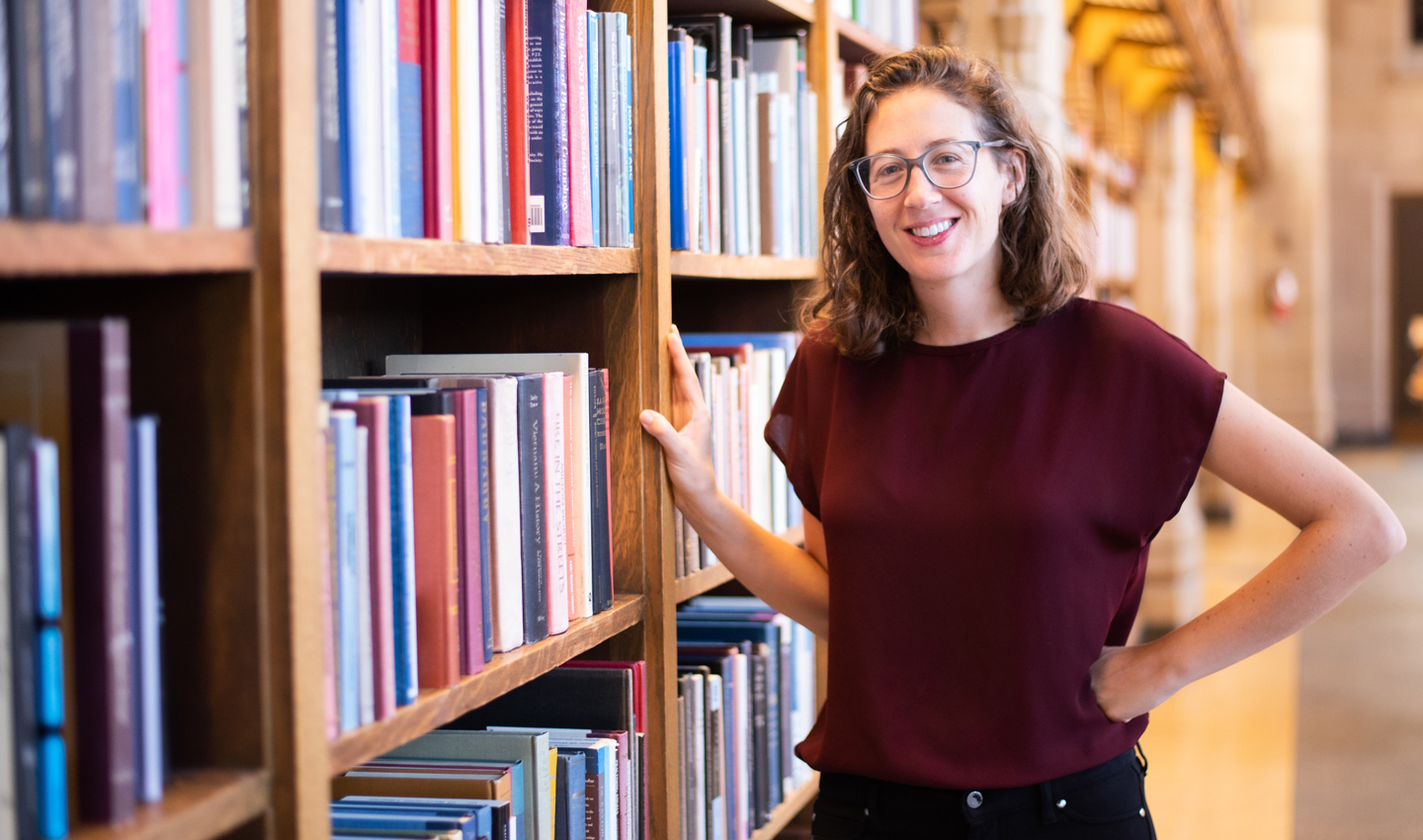
Information School Assistant Professor Melanie Walsh describes the bridge between librarianship and information science as a “dynamic combination.” Through the Master of Library and Information Science course LIS 572: Introduction to Data Science, Walsh is able to lead her students across this bridge.
Walsh (pictured at top) earned her Ph.D. in English Literature at Washington University in St. Louis, Mo. During her Ph.D. program she learned to code, which inspired an interest in the intersection of humanities and data science.
Before Walsh arrived at the Information School, LIS 572 was mostly a traditional data science class. She was eager to reimagine the course’s curriculum, shifting the focus toward data science within libraries, literature and culture.
LIS 572 still provides students with the experience of working with and manipulating data, understanding data ethics and an introduction to programming. But it also grants students a better understanding of data’s relevance to libraries while considering technical, philosophical and political concerns.
The course, offered both online and in-person, provides hands-on-experience with real-world datasets. LIS 572 students work with checkout data from the Seattle Public Library System, visitor data from the National Park Service, and data concerning translated books. At the end of the quarter, students complete a final project analyzing a dataset of their choice. Walsh said that, for her, the final projects are the “most rewarding part” of the course.
During the in-person classes, Walsh strives for peer-to-peer learning so students can learn from each other’s strengths. “It’s a way of leveling the playing field,” she said.
While analyzing recreational visit data from the National Park Service (NPS), one student found a digital portal via the NPS website that provided exact detail on how each park counts visits and a log of anything that went wrong at each site.
“Library students in particular are so good at finding information, reading documentation and really digging into the weeds,” said Walsh. “That illuminates to me the great possibilities of the library students interested in data.”
Ryan Murtfeldt, MLIS ’24, took LIS 572 in 2023 and was involved with the Center for Informed Public during his time at the Information School. The summer after taking Walsh’s class, he was completing a literature review for the CIP and needed to access a lot of data from a research database — specifically 30,000 results. But the database limited results to 1,000.
Remembering Walsh’s class, he asked if he could access the database through the website’s application programming interface. He got the results he needed, yet did not understand how to work through them. Walsh offered initial advice, and then Murtfeldt continued to learn on his own.
“I’ve taken those skills and ran with them,” Murtfeldt said. He now works as a Decision Science Analyst at Hagerty Insurance.
Another former student of Walsh, Connor Franklin Rey, graduated from the MLIS program in 2024. Rey now works as an Assessment Librarian at San Diego State University, evaluating the library’s services and collections.
Rey took LIS 572 during their first quarter of the MLIS program. Learning critical data literacy skills from Walsh set them up for success at their current position. “It was a very impactful class for me in terms of my career,” Rey said. “It enlightened me to a whole world I didn’t know about.”
Walsh and Rey — along with Tina Nowak, MLIS ’24, another former student in LIS 572, as well as other collaborators — have coauthored a research paper titled Algorithms in the Stacks: Investigating Automated, For-profit Diversity Audits in Public Libraries, published at the ACM Conference on Fairness Accountability, and Transparency (FAccT). In public libraries, audits are done to identify diversity in the library’s collections. However, there are nuances to diversity that a computational program can’t identify. Additionally, the vendors offering these tools are the same vendors selling books to the libraries.
Walsh and Rey analyzed these complexities and will present their paper at the American Library Association Annual Conference this June.
Data is used in many manipulative ways, and Walsh hopes to combat that by arming her students with data literacy skills. She hopes her students will walk away with a deeper understanding of the complexity and power of data and how this data can be used for good, especially regarding the advancement of libraries and archives.
Walsh acknowledged that students, especially those from the humanities, must shift their mindsets when coding.
At the start of each quarter, Walsh relives the same experience: “It didn’t work,” a student says after their first attempt at running a line of code, looking up at Walsh with a furrowed brow. Walsh just laughs to herself. “You have to embrace failure,” she says.
Coding is rife with mistakes. Acknowledging that receiving a red error code is hard, Walsh tells her students to exist in the uncertainty.
“Allow yourself to feel a little overwhelmed.” The euphoria felt once a code works is the satisfying flip-side of all that frustration, Walsh said.