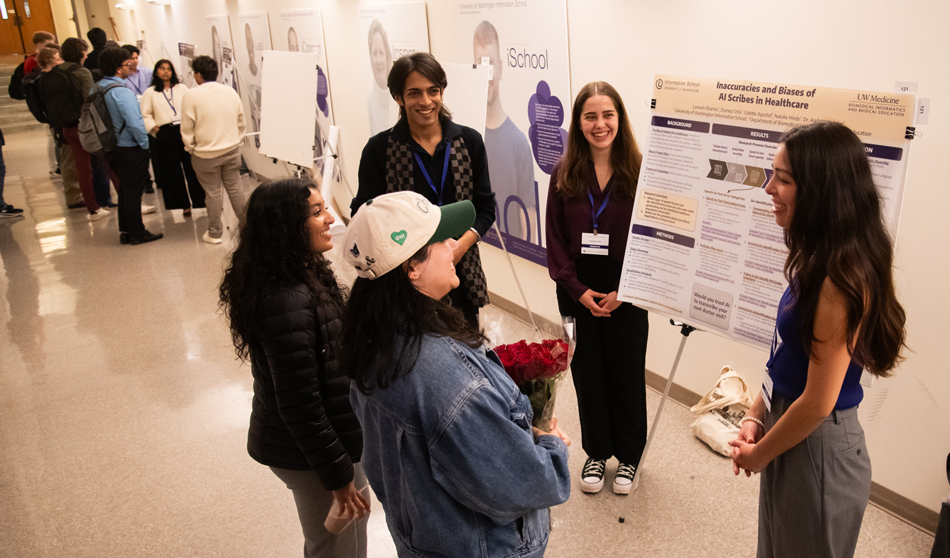
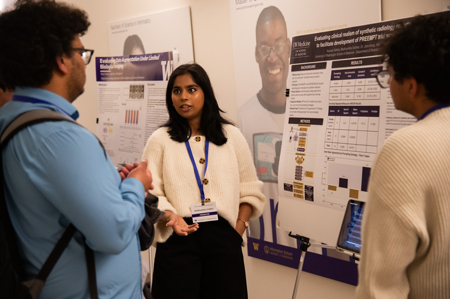
More than 40 Information School undergraduate students presented their research projects recently at the 2026 Undergraduate Research Symposium.
Held on May 15, the 28th annual University of Washington Undergraduate Research Symposium showcased interdisciplinary undergraduate research from across the three UW campuses. More than 1,500 students participated in the event, including 42 Informatics students who presented oral presentations, poster sessions, visual arts and performances.
Senior Hamza Eqbal presented his research, "Practical and Policy Challenges in Enterprise Cybersecurity," analyzing large-scale security breaches of enterprise environments in the past five years using a case studies approach. Looking at the challenges of cybersecurity in enterprise environments, he found that software supply chain risk was the biggest challenge in the enterprise environment.
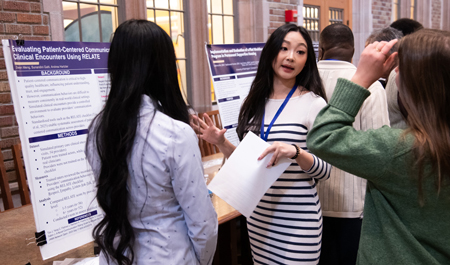
Also researching cybersecurity, Junior Leisha Bajaj looked into the issue of credential stuffing, which is the term for a cyberattack where criminals gain unauthorized access to online accounts because of password reuse.
Her project modeled a log-in system for a small business website to investigate which password defense measure is the most effective against credential stuffing. Bajaj, who is pursuing a minor in Business Administration, chose to focus on small-business sites because they lack the resources to defend against credential stuffing and are disproportionately affected by it.
In her testing of four defense mechanisms, she found that limiting the number of log-in attempts was the best defense method for the small-business account log-in system.
Another project investigated how anonymity influences cyberbullying. Junior Ada Chen developed an interactive social media app prototype where instances of cyberbullying could be reported to encourage accountability and support an increase in trust online. The model also simulates a learn-and-practice feature that encourages users to practice responding to cyberbullying.
Her results found that integrating educational interventions that address anonymity concerns within the app’s design helps to promote safer online communities.
“After conducting all my interviews, I feel like a lot of the users mentioned that having the interactive module really helped them understand what cyberbullying was, especially what actions to take when someone is experiencing cyberbullying,” she said.
Some projects also incorporated concepts of identity with information. Senior Shirley Yun presented their project, “Re: Saving my Digital Memory, for the Future of Us,” at the Visual Arts and Design Session.
Yun developed a program that continuously records their computer, drawing on concepts from their Digital and Experimental Arts minor to demonstrate the recording of their own online persona embedded in the data of all the devices they’ve ever had.
“I’m very interested in online culture: who you are online, your persona, sort of that image of yourself that can be gained from online,” Yun said.
Taking information from their phone, such as daily step count and old Instagram usernames, they created a data set and paired it with a 3D scan of their room displayed on the screen of the presentation.
“I like the sort of relationship between there being a physical space but then within that physical space, these digital actions are happening or there are these points of myself that can only be trapped through my devices,” Yun said.
Cultural identity also motivated research this year.
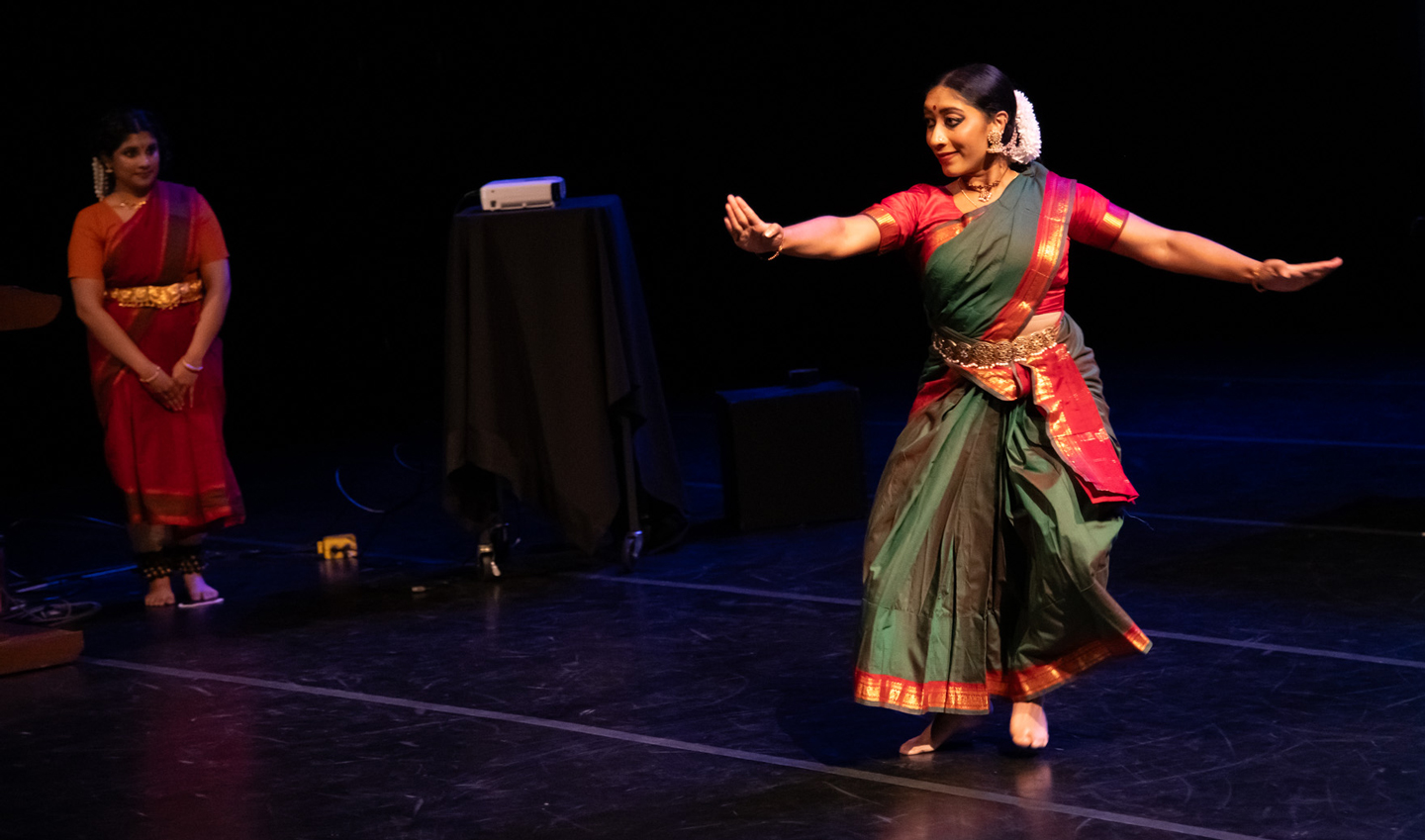
Senior Neha Venkatesh (pictured at top) investigated the intersection of traditional dance pedagogy and biomechanics. As a dancer herself, Venkatesh studied the practice of Bharatanatyam, a traditional dance in India. By studying standardized instructional cues, Venkatesh discovered that traditional dance instructions fail to account for individual body differences. Her project proposed a shift toward a more personalized and anatomy-informed teaching.
“The Informatics program gave me a strong foundation in research methodology, which was central to how I approached this project,’ she said.
Venkatesh and her co-presenter Aadya Bhat, a neuroscience student, presented at the performing arts section of the symposium. “We loved being in a space where artistic and scholarly work intersected,” she said.
Senior Yoonsoo Cho’s research, titled “결 (Gyeol),” explores the intersection of her cultural heritage and generative AI.
During an university exchange program, she attended a university in Korea last year where her love for her Korean culture grew exponentially.
“I felt really saddened by how the current AI models are very westernized. The data sets are created and based on a westernized data set, so everything they create and reinterpret of an East Asian culture is all westernized,” she said.
Cho trained an AI model using Korean patterned textiles to replicate and then transform a generative AI system to create its own Korean-style patterns while maintaining the culture and visual identity.
With such breadth of research focuses and opportunities, the Information School encourages Informatics students interested in research endeavors to find opportunities through the Research in the iSchool Canvas page. There are many chances to work with iSchool faculty, gain research experience or even participate in research projects for course credit.