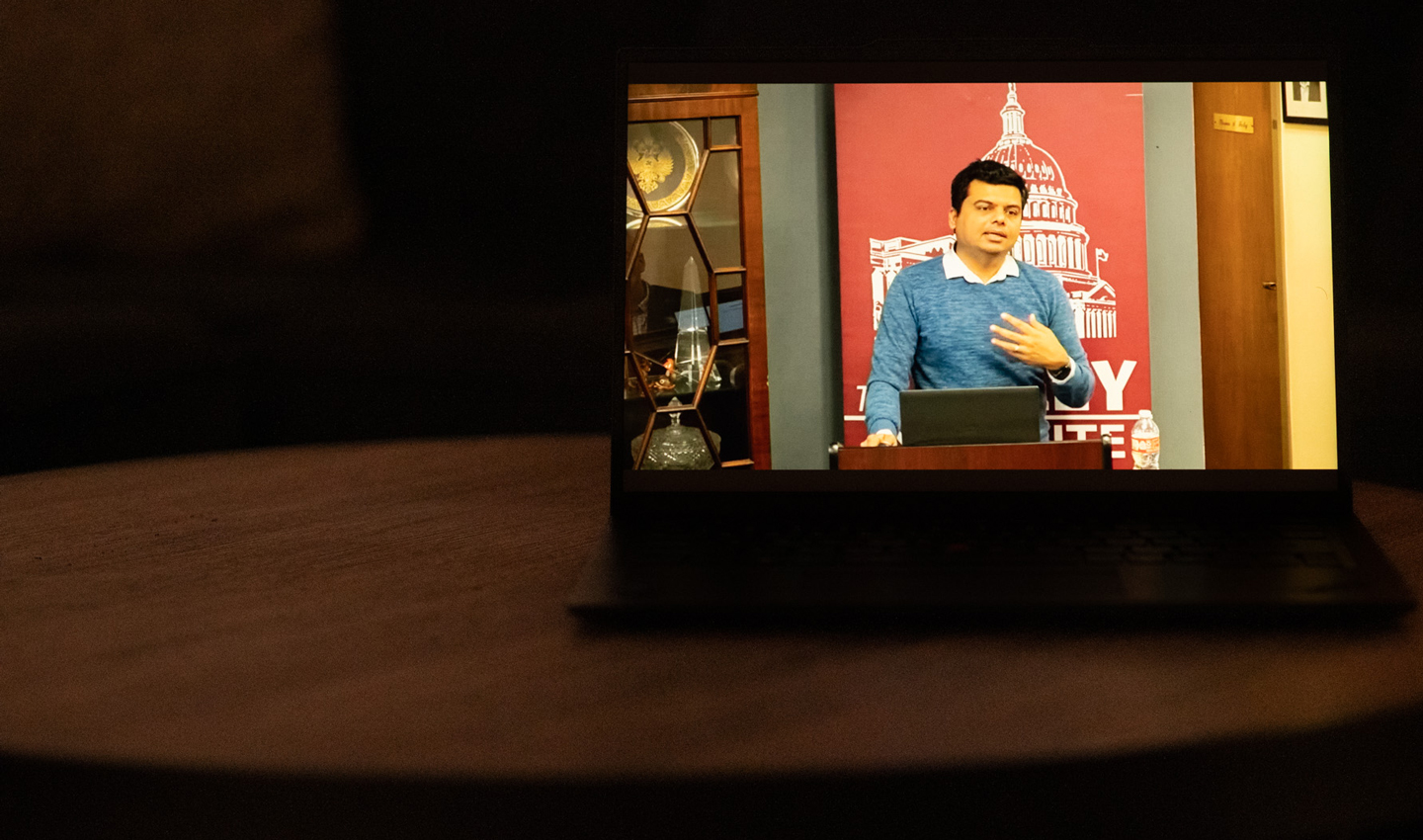
AI’s increasing integration into modern life has sparked fear and uncertainty among the public. With that in mind, Information School Professor Chirag Shah has started a series of talks on the uniqueness of being human amid the rise of artificial intelligence.
Shah kicked off the two-year series Jan. 26 with an online presentation titled “Being Human in the Age of AI.” Shah sought to provide his audience with a set of deeper questions concerning AI’s impact on the collective future of humanity.
The series is hosted by Humanities Washington, a non-profit organization with a goal of provoking discussion and encouraging deep thinking. Every couple years, Humanities Washington selects several individuals to provide talks across the state as a part of its Speakers Bureau. Shah, who has been selected for the 2026-2027 Bureau, will use the forum to spark conversation on the intersection of AI and human behavior in libraries, museums and universities statewide.
For these talks, Shah said he is not just concerned with the implications of AI that mainstream media typically cover, such as the negative effects on jobs or education. Rather, he is concerned with its implications for simply being human. The presentation highlighted what humanity thought were uniquely human traits — creativity, emotional intelligence, ethical reasoning and meaning-making — and how AI has been integrated into these domains, causing humanity to rethink “what it means to be human.”
There are three ways AI can be employed in humanity, Shah said, referring to these processes as preservation, augmentation and integration.
Preservation refers to prohibiting AI from specific human-centric realms. Augmentation refers to utilizing AI as a tool humans can use to enhance their capabilities. Integration refers to an embodied AI, in which humans lose the ability to define themselves as human.
The talk was accompanied by slides containing thought-provoking questions and images that complemented Shah’s discussion. He encouraged his audience to participate during the presentation, asking hypothetical questions the audience answered with a show of hands and giving them a chance to ask follow-up questions.
“We are never going to have all the answers, but we have no chance of getting anywhere if we are not even asking the questions,” Shah said.
As the presentation concluded, Shah took the time to thoughtfully respond to each question, addressing inquiries on privacy concerns, individual choices and human connection. The Q&A came to an end only after the event’s moderator declared the last question.
Shah commended his audience for taking an active role in the discussion. “You don’t need to have a college degree or a government office or deep pockets to be engaged in this conversation,” he said. “You can’t afford to be on the sidelines.”
He said he hoped his audience would be able to walk away from his presentation with the necessary language to continue these kinds of discussions. The goal of his talk was not to answer the world’s burning questions on AI’s impact, but to get viewers thinking about its impact, especially how AI affects the art of being human.
“This talk is not about technology,” said Shah. “It is about us.”
Shah’s next talk will take place in person at the Mountlake Terrace Library on Feb. 28. The following event is hosted online on March 9. Subsequent events can be found through the Humanities Washington event page.
Pictured at top: Professor Chirag Shah delivers a "Being Human in the Age of AI" talk online from Pullman, Wash., on Jan. 29.