
iSchool Capstone

2019

Project Logo

Privacy Pal: Empowering Digital Youth Through Microlearning

Today’s technical landscape is constantly changing; in many ways this increased innovation is beneficial. However, continuous innovation also means practices and technological norms are changing at a fast pace. The majority of today’s youth are growing up with technology firmly integrated into their lives. We see it as our duty to educate kids on these potentially dangerous norms and practices they are at exposed to on a daily basis. PrivacyPal serves as a modernized education tool to meet these goals: protecting and empowering kids to create an informed and healthy relationship with technology.
Project Logo

Robo-a-gogo: Participatory Design S.T.E.A.M. Teen Programming In the Public Library

We designed and implemented a 10-week participatory design STEAM program for teens at Seattle Public Library. The program was held at Rainier Beach branch and eight teens ages 12 to 14 participated. Using KidsTeam UW as a model, we utilized techniques in codesign sessions including paper prototyping, creative narrative, big paper, stickies, and more. Design sessions culminated in participants building robots using Arduino. Data collected included analytical memos, recorded session video, and photographs. Lastly, we coded, analyzed, and synthesized to write design recommendations for Seattle Public Library to inform further iterations of participatory design and Arduino youth programs.
Project Logo

Virtual Reality: Designing Curriculum for Teenagers in Libraries

To learn about the potentials of Virtual Reality, we designed a curriculum for teenagers, called VR Camp, taught over spring break at Snoqualmie Public Library. It was divided into three modules; each exposed students to different ways of interacting with VR and paired those experiences with participatory design activities. This VR program served as a pilot for a larger research project at the UW. Funded by a grant from the IMLS, this project brought VR to incarcerated youth in Snoqualmie Valley. Findings from VR Camp and the larger project will help inform the creation of a library practitioner toolkit.

2018

Project Logo

A Book for Every Reader: Collection Maintenance at ReWA

Refugee Women’s Alliance’s Early Learning Center is a preschool for children three to five years old, providing multilingual and multicultural childcare and education. The ELC’s classroom libraries are made up of primarily donated materials, and therefore have no cohesive organizational structure. ReWA’s ELC preschool teachers needed an organizational system for their classroom collections, as well as instructor guides to aid them in identifying books for lessons on specific subjects. After completing an inventory and evaluation of the collection our team developed an organizational system, identified gaps in the collection, and offered recommendations to fill those gaps.
Project Logo

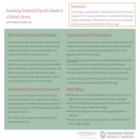
Assessing Student and Faculty Needs in a School Library

In response to a school librarian’s concern about underutilization of library resources and services, we developed surveys to gather baseline qualitative and quantitative data about student and faculty use and expectations of the library. We found that many students and faculty lack the time to seek out meaningful relationships with the library, contributing to inconsistent information literacy instruction and underutilization of library resources and services. We reviewed the data with our sponsor and co-developed ideas for addressing barriers to library usage, including partnering with student groups to brainstorm outreach initiatives and advocating for an integrated information literacy curriculum.
Project Logo

Books Behind Bars

What does library access look like for incarcerated youth? There have been few studies on this subject. What we do know is that there is no legal entitlement to library resources for detained youth. This means incarcerated youth have no right to independent legal information, independent sexual health information and even recreational materials. Because Juvenile Justice Systems differ from state to state, the best way to access this information gap is to look at each state individually. The State of Utah served as a pilot study to find the best way to research this area of library science.
Project Logo

Children Choose: Children's Advisory Boards in Libraries

Children’s collection development and programming is implemented by adults based on librarians’ knowledge of what children might need. Libraries are missing direct input from elementary-aged children regarding books and programming. Our Capstone team created a research-based framework to implement Children’s Advisory Boards (CABs) in libraries. In a CAB, a group of children advises the library on collection development and programming. Using best practices that emerged during our eight test CABs, we created a toolkit for our sponsor, the Collaborative Summer Library Program. Librarians nationwide can use this toolkit to invite children’s voices into their libraries.
Project Logo

Developing and Presenting Spanish Story Times by Non-Spanish-Speakers

The responsibility for Spanish story times at Provo City Library has rested on one native Spanish-speaking storyteller for many years. To ensure the ability to provide continuing Spanish programs, the Children’s Services Manager desires to expand Spanish programming staff to also include non-Spanish-speaking librarians. I therefore researched best practices for story times, observed bilingual programs at nearby libraries, and created a set of bilingual story time scripts for use by non-Spanish-speaking librarians. This will make a difference for the city’s Hispanic and Latino population who will gain confidence in the library's commitment to their families.
Project Logo

DiscoverEd

DiscoverEd is a web application that helps special educators find technology to support students with special needs. Special education programs in the US are on the rise, with 30% growth over the last decade, and encompassing both disability needs and supplemental needs programs. However, special educators struggle to find the right technologies to fit the needs of their students, spending time scouring the internet looking for answers. DiscoverEd will become your closest colleague, learning about your teaching environment and then connecting you to the best technologies for your students, and fostering a collaborative community for like-minded special educators.
Project Logo

Dumb Ways To Die... On Mars!

Dumb Ways to Die… On Mars is a STEAM program, modified and designed to make STEAM programming accessible to underserved and low-income communities. Each component of the project can be done at little to no cost, and participants learn about the engineering process, write a letter to NASA, build a Mars rover, and expand on critical problem-solving skills all to answer the question: how do we, as humans, survive on Mars? The project includes lesson plans, an in-depth PowerPoint presentation, and ELA and math standards, all downloadable for free from an easily-accessible website. Website: http://dumbwaystodieonmars.wordpress.com