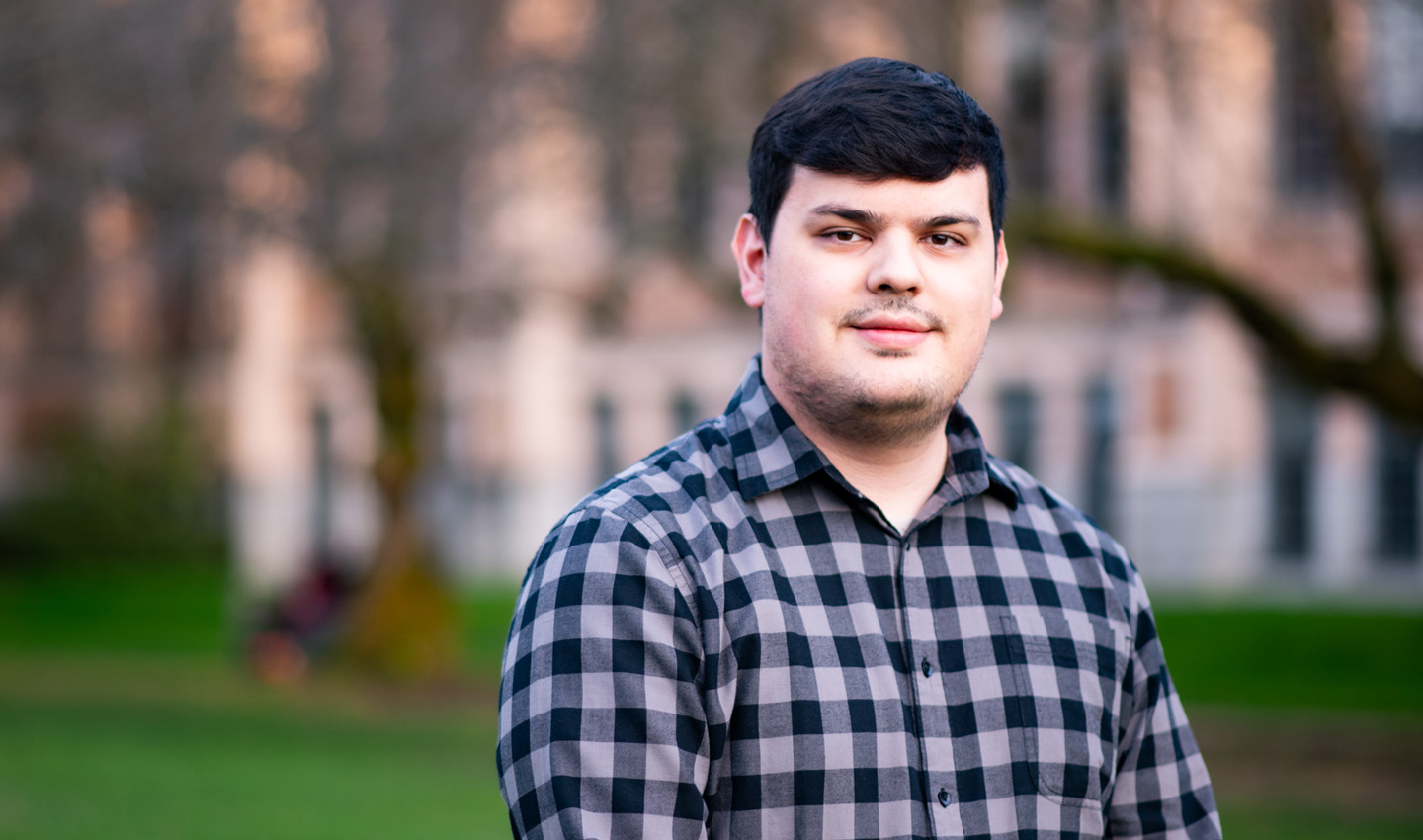
Growing up in a small town in Central Washington, Diego Licea aspired to attend college and set his sights on the University of Washington.
“I'd heard it was a challenging school to get into,” he said. “If it wasn't UW, I felt like maybe I had sold myself short. So I applied during my senior year, and I was able to get in.”
Now as a junior in the Informatics program, Licea continues to make his mark on the Information School community.
After completing the Running Start program in high school, he originally planned to major in history, but once he got to campus, he took some time to explore different possibilities before choosing a path.
His advisor told him about the Informatics major and he found that the program sufficiently integrated his interests in the humanities with his desire to learn more technical skills in a STEM field.
“It sounded like something that kind of blended together my interests at the time, as well as some technical things that I was also interested in and I wanted to build my skills in,” he said. “I think sometime after taking INFO 200, it all just kind of clicked.”
In addition to studying Informatics, Licea also works as an academic peer advisor, meeting with other undergraduate students who are interested in the Informatics program or simply looking for some advice while navigating college.
“I thought back to how much all the advisors that I've had over the years have helped me shape who I am and the career that I'm pursuing, and made me feel stable in my decision here at UW,” he said. “I felt like through this role I could do my part now and give back to the community and help make someone else feel confident in their decisions as well at UW, whether that's academics, choosing classes or even something big like what major they should do.”
Being able to give back to the UW community was an important goal for Licea, and he found peer advising to be the perfect opportunity to do so.
“We have a lot of first-years that come in asking about how classes work, what the best classes are, what they should take based on their careers, and other questions like that. It's been so fulfilling and really everything I ever wanted in terms of giving back to the community in some way,” he said
Licea has incorporated his background in history with his projects at the iSchool. During his sophomore year, he appeared as a guest on iSchool Professor Joe Janes’ podcast “Documents That Changed the World.” During his episode, he discussed the Inca civilization’s practice of Quipu, which is a collection of strings made from cotton or animal fibers containing patterns of knots that the Incas used to communicate numerical information.
He had taken Janes’ honors class, now INFO 357, about how documents shape societies and wrote his final paper on the Incan Quipu, describing how this system of communication serves as documentation of a historically important writing system that risks being lost. Janes reached out to Licea and asked him if he would like to co-host an episode on his podcast about the topic.
“It was kind of the first moment where I thought my interests and my expertises that I got from Running Start are applicable to this major. They're valid and they're so useful still, even if I didn’t start out as the stereotypical STEM student,” Licea said.
“I can still apply my concepts, and they can be useful and interesting to someone. That was really impactful for me.”
Licea is also a recipient of the Richard E. Dakin Cybersecurity Scholarship, which has helped him meet one of his and his family’s hopes: to graduate from college without debt.
“This scholarship that I received from the iSchool, from the donors that were gracious enough to award it to me, helps keep one thing off my mind that was really scaring me and my parents a lot,” he said.
“I'm just so grateful for it and it's so relieving. I have so much stuff going on and so many things that I'm thinking about, but I’m glad that money isn’t one of them.”