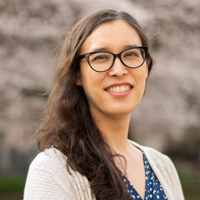
I have invited Amy J. Ko, Professor and Associate Dean for Academics, to write about our educational mission and how, 25 years in, the Information School is adapting to meet the current moment.
— Anind K. Dey, Dean and Professor
The ways we seek and use information are constantly evolving. Oral traditions gave way to early writing systems and eventually the printing press. Mass media expanded from newspapers to radio and television, and then later the internet and social media took hold. Each development has transformed society, and we are in another transformational moment now with the emergence of artificial intelligence.
The Information School was formed out of one of these sea changes: Amid the development of the internet in the late 1990s, UW leaders recognized that it would change the world in unpredictable ways. While computer science would focus on the rapid computational innovations driving that change, information science aimed to find and build solutions, technological and otherwise, to the hard questions that arose as the internet disrupted society. Now, at the same time AI has made computing easier by automating complex tasks such as coding, it has made those questions even harder.
What are the use cases for AI in education, industries and our personal lives? What information can you trust it to provide? Should children use AI in their classrooms, and if so, how and why? Must we just accept what giant tech firms decide to unleash on the world or do the rest of us get a say? Those questions are at the heart of our teaching and scholarship at the Information School. The future is with us, and we are responding in ambitious ways.
We are transforming our academic programs, educating students on how to make thoughtful decisions about whether and how to use AI in their future roles and organizations, and we are reaching beyond the Information School. One of our professors, Ben Lee, has developed an Informatics course in AI fundamentals that will be available to all undergrads this spring. Our Information Management master’s program has added an AI specialization. Our Master Library and Information Science program is teaching what LLMs are and what they aren’t, and all the threats they pose to authorship, knowledge and knowing. And we are exploring new graduate certificate programs that respond to the needs of professionals in industry, nonprofits and government who wonder how AI might (or might not) transform organizations, products and services.
We also know we need to adapt what K-12 educators learn to teach, which is why we have partnered with the College of Education to develop courses that approach computer science and information science with a critical, justice-focused lens. The teachers gain not only an understanding of the mechanics of computing, but also its societal implications, and their students across the Pacific Northwest learn that they deserve agency in shaping how computing, information and AI shape their lives and communities.
Outside the classroom, we’re leading community initiatives to promote media literacy and help people spot misinformation, scams and phishing. Through our school’s Co-Designing for Trust project, researchers are out in communities, helping librarians and educators design solutions that people will actually use to find trusted information. Library staff and researchers have partnered to create a suite of resources including teaching guides, online quizzes, in-library displays and library programming.
Meanwhile, we’re also lending policymakers our faculty’s expertise in technology and youth development. For example, Professor Katie Davis testified at the state Legislature last month on a bill that would regulate companion chatbots to address concerns about their effects on young people’s mental health. Personally, I serve on the State Board of Education’s FutureReady subcommittee, which is making K-12 student learning recommendations for computer science, technology and media literacy. With the help of many voices across the state, including teachers, nonprofits and youth, we're helping determine what our state's youth will learn in the coming decades.
As we navigate the current technological transformation and whatever comes next, Information School students and alumni will be critical to realizing a world that puts people first. Individuals and communities should be empowered in shaping policy, in their own learning, in creating their own visions for information technologies. It’s our future to shape as we want.
Amy J. Ko, Ph.D.
Professor and Associate Dean for Academics
Winter 2026