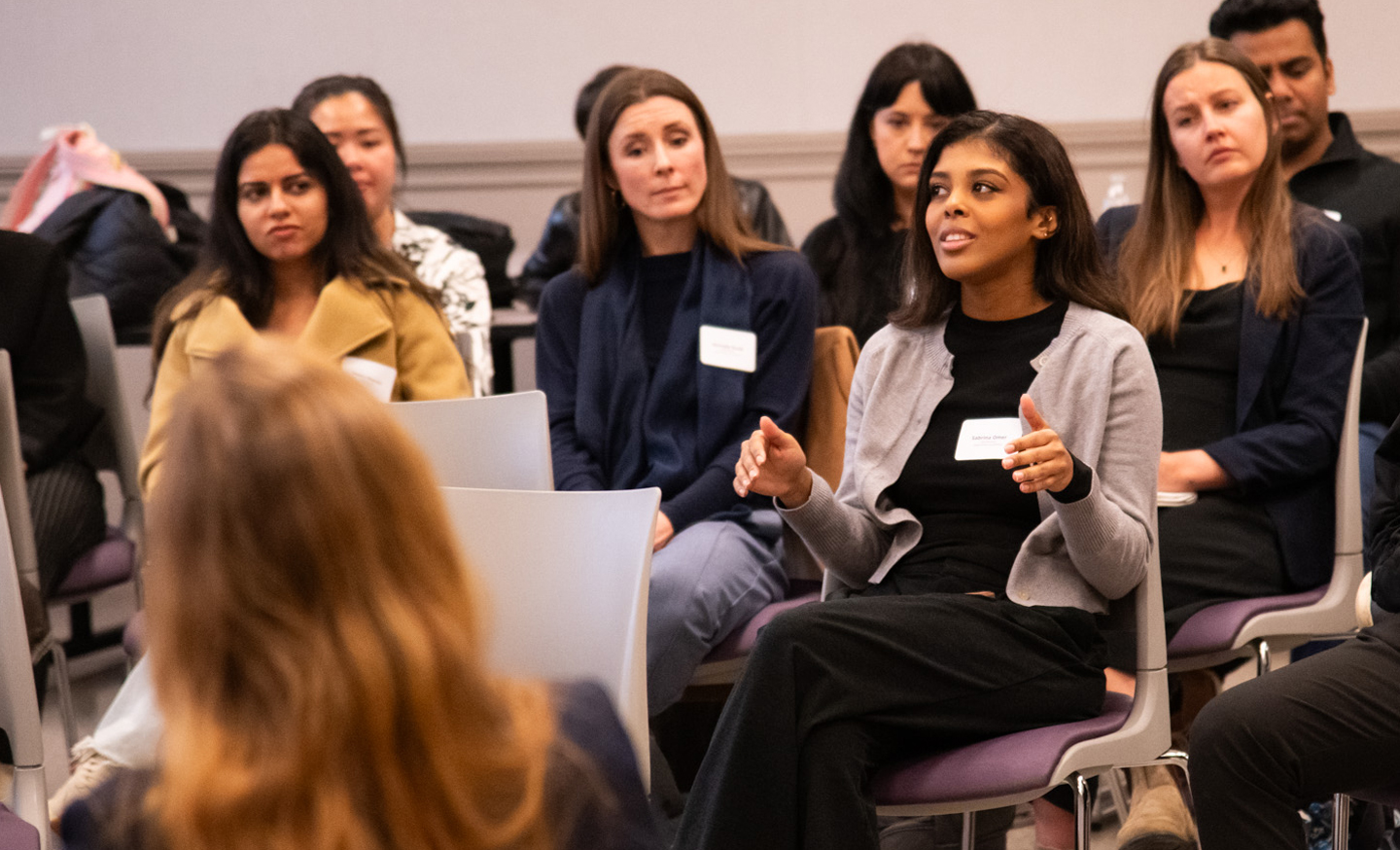
About 50 online students and several alumni from the Information School’s Master of Science in Information Management program discussed sustainability in information management at the fourth annual MSIM Online Student Summit.
The Feb. 6-7 summit began with a Friday evening welcome reception in Kane Hall. Dean Anind Dey welcomed MSIM online students and alumni to the Seattle campus and UW community.
“As online students, you are deeply embedded in your professional lives and communities around the world, and today you're physically here,” he told them.
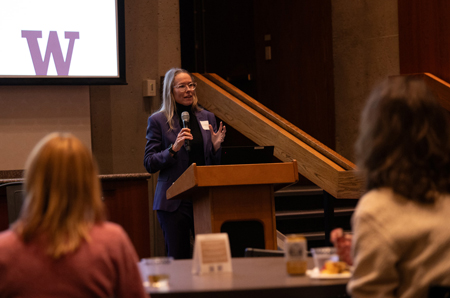
Dey introduced this year's summit theme of Sustainability in Information Management, identifying that although sustainability does not seem explicitly associated with information management, it remains an important aspect in the field.
“As MSIM students and emerging leaders, you're uniquely positioned to champion sustainability in the tech industry. Whether you're improving data practices to save energy, shaping responsible AI policies or designing tools that help communities thrive, you can be driving meaningful change, even if sustainability isn't explicitly your job description,” he said.
MSIM Program Chair David Hendry then introduced the summit keynote speaker, Kris Tomasovic Nelson, an MSIM ’15 alum who is the head of global sustainable investing and a senior portfolio manager at Russell Investments.
Nelson explained that while the MSIM program explores the relationship between information, technology and people, sustainable investing is similarly rooted in a people-centered framework.
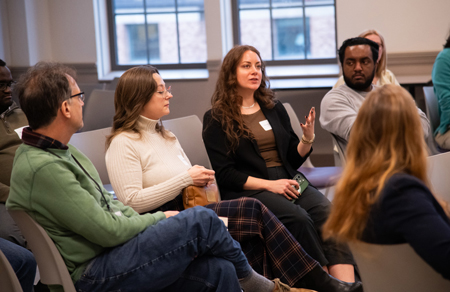
“People often describe sustainable investing as people, profit and planet,” she said, noting the clear overlap with information management.
She emphasized that investing itself is fundamentally an information problem, since decisions must be made under uncertain conditions.
“Sustainable investing is still investing, but it’s investing with a wider set of decision inputs,” Nelson said.
Saturday’s events featured various workshops, including a “fishbowl conversation” about the book “Work: A Deep History, From the Stone Age to the Age of Robots” by James Suzman.
The book examines human relationships with working and how it has evolved from the Stone Age. iSchool Associate Teaching Professor Heather Whiteman presented the question to the group, “Are we hardwired to work?”
MSIM alum Yuriy Kim said, “For the most part, I expected to work since I was a child because our education system trained us to read and write. So I never really questioned, do I need to work? Yes, I do because since I was a small kid I was programmed to do it.”
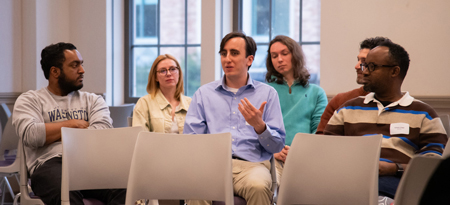
Others found that work is part of our individual human experience, making up our identity or giving our time a sense of purpose.
“I think it’s not only that we are trained to work from the beginning, as a child, it’s an innate identity to some people … I think human beings cannot survive if they are not working,” said MSIM student Eshetu Daga.
After the fishbowl session, attendees connected over lunch and before participating in additional discussion sessions throughout the day such as, “How NOT to Fall in Love with your AI Assistant” by Assistant Teaching Professor Wes King and “Co-Designing Environmentally Sustainable Futures with Global Indigenous Communities,” with Assistant Professor Jason Young.
Pictured at top: Sabrina Omer speaks during the fishbowl conversation on Saturday, Feb. 7.