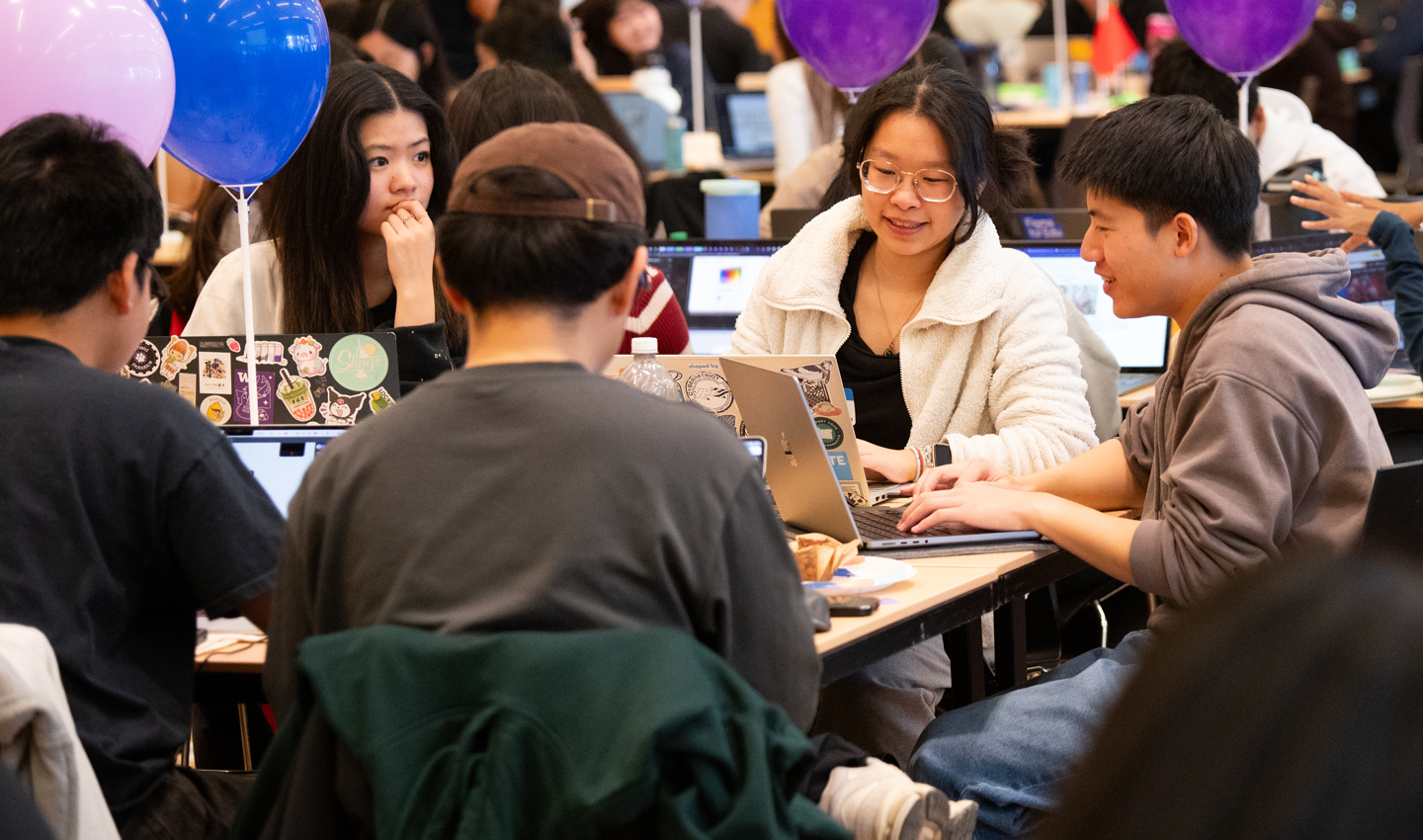
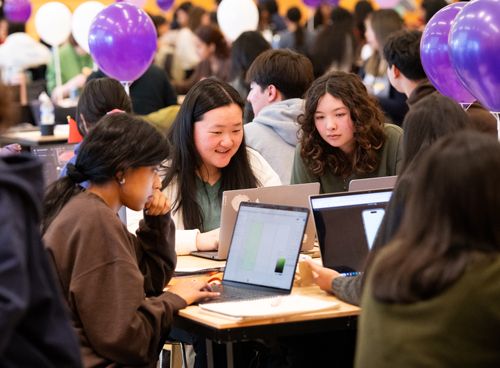
The HUB ballroom filled with the clicks of keyboards and conversation as University of Washington students collaborated during the 14th annual Winfo Hackathon. Over the course of 12 hours, students swam together in the currents of innovation, pushing the boundaries of creativity and ingenuity in the vast ocean of software design.
The Hackathon is beginner-friendly and directed toward Informatics underclassmen, though the event welcomes students from all majors and class standings. A total of 341 attendees showed up, ready for the all-day event on Jan. 24, including 256 participants, 35 Winfo volunteers, and 50 alumni and faculty members, each eager to collaborate and deepen their collective understanding of technology’s capabilities.
“Depths of Discovery, Currents of Creation,” was this year's theme, encouraging exploration and creativity among the ebbing and flowing tides of technology. The theme’s message inspires students to jump head-first into collaborative problem solving and to devise solutions that will create a positive effect in the realm of technology.
 “This year’s theme highlights why Informatics is so important,” Information School Dean Anind Dey said in his opening address. “It's this great combination of STEM … along with the very best of humanities: critical thinking, communication and ethics.”
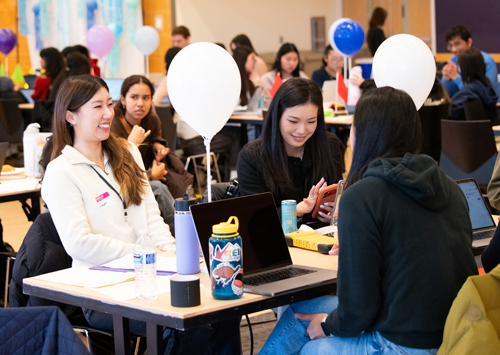
The Hackathon creates a sense of community among students involved in technology, information and design at the UW. It allows students to spend a day with peers in similar domains, collaborating, problem solving and creating new ideas. The event is also a good opportunity for students to network, gain experience and design projects for portfolios.
Annabel McDonald, a third-year Informatics student, said her reason for participating was to build her resumé. “Informatics majors need a lot of portfolio items and experiences,” she said. McDonald also took advantage of the networking opportunities that the Hackathon provided, as various tech-based companies tabled in each corner of the room.
Winfo, or Women in Informatics, is a student organization at the UW that works to create opportunities for women in the field of technology, boosting their confidence. Tamara Luu, a senior in Informatics, advised fellow women in technology to “be confident in what you want to do.” “At the end of the day,” Luu said, “it is just you and yourself.”
Maya De Jesus, a third-year in Informatics, and her group spent their time at the Hackathon designing a networking program that would make it easier for women to stick together in the workplace. The program, Mentorly, creates a community for Black and Latino women in technology and in corporate settings. Mentorly grants them a forum to vent, discuss issues, seek advice and share tips. “It is OK for women to take up space in this field,” De Jesus said.
 Several networking programs were designed during the event, each serving its own purpose. Knot, designed by third-year Informatics student Sanam Karmi and her group, serves as a WiFi network finder, intended for those who work remotely or who utilize coworking spaces.
However, there were many programs designed for other purposes as well. Luu and her group created an educational iPad game fabricated for Gen Alpha to address concerns about the illiteracy rates of younger generations. The group’s app focuses on teaching the phonetics of a language, delineating mouth movements and matching those movements with sound production. The program could be utilized by second-language learners as well.
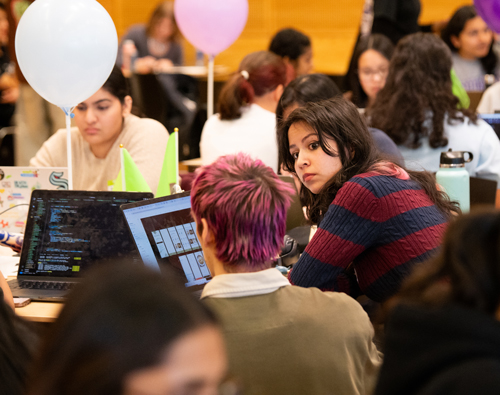
Several rounds of mentoring occurred during the Hackathon, during which students put up green flags to call for an available mentor.
Dean Dey, Professor Joseph Janes and Alexander Honeycutt, a custom software engineering specialist at Accenture, each gave speeches to kick off the event. Keynote speakers play an important role at the event, educating and inspiring future technologists and designers. Hackathon Director, Renee Singh said, “From my side, the largest takeaway was the focus on exploration and discovery.”
At the end of the day, four teams were selected for awards.
NewFuse won the Best Product award. Created by Sophia Wei, Angela Yang, Thu Doan and Thu Nguyen, the idea for NewFuse is to make news understandable and accessible. It addresses issues such as excess information, news comprehension and disengagement of younger generations in news media.
 The Best Impact award went to Vania Benitez Salgado, Kai Barnum and Pimnipa Thawai for their program, Canario, which would enhance preparedness and education regarding ICE encounters. The app would indicate areas with increased ICE activity and contain an alert button that sends a notification to pre-selected contacts during a potential encounter.
Isaiah Hoagland, Sunny Tian and Farrel Sudrajat won Best Design for their fantasy WNBA app. Their program would address the complicated nature of traditional fantasy sports, tailoring fantasy WNBA toward new sports fans. With women’s sports rising in popularity, the program’s goal is to continue to boost fan engagement.
Finally, Best Implementation went to Nudge, created by Sacchin Saravanan, Abhinav Vallabhaneni, Achintya Agrawal and Aashi Juneja. Nudge addresses excessive screen time, particularly among college students. Its solution is to rewire users’ relationship with their screen in a gentle way, redirecting students’ focus to their tasks at hand.
As it does each year, the Hackathon provided a valuable experience for Informatics students, allowing them to build skills, make connections and practice designing.
“When there is an opportunity, like this one, make sure to take it,” Karmi said.