The challenge for many companies these days isn’t simply finding talented employees; it’s retaining them.
High compensation? Remote working opportunities? These perks don’t always keep workers around.
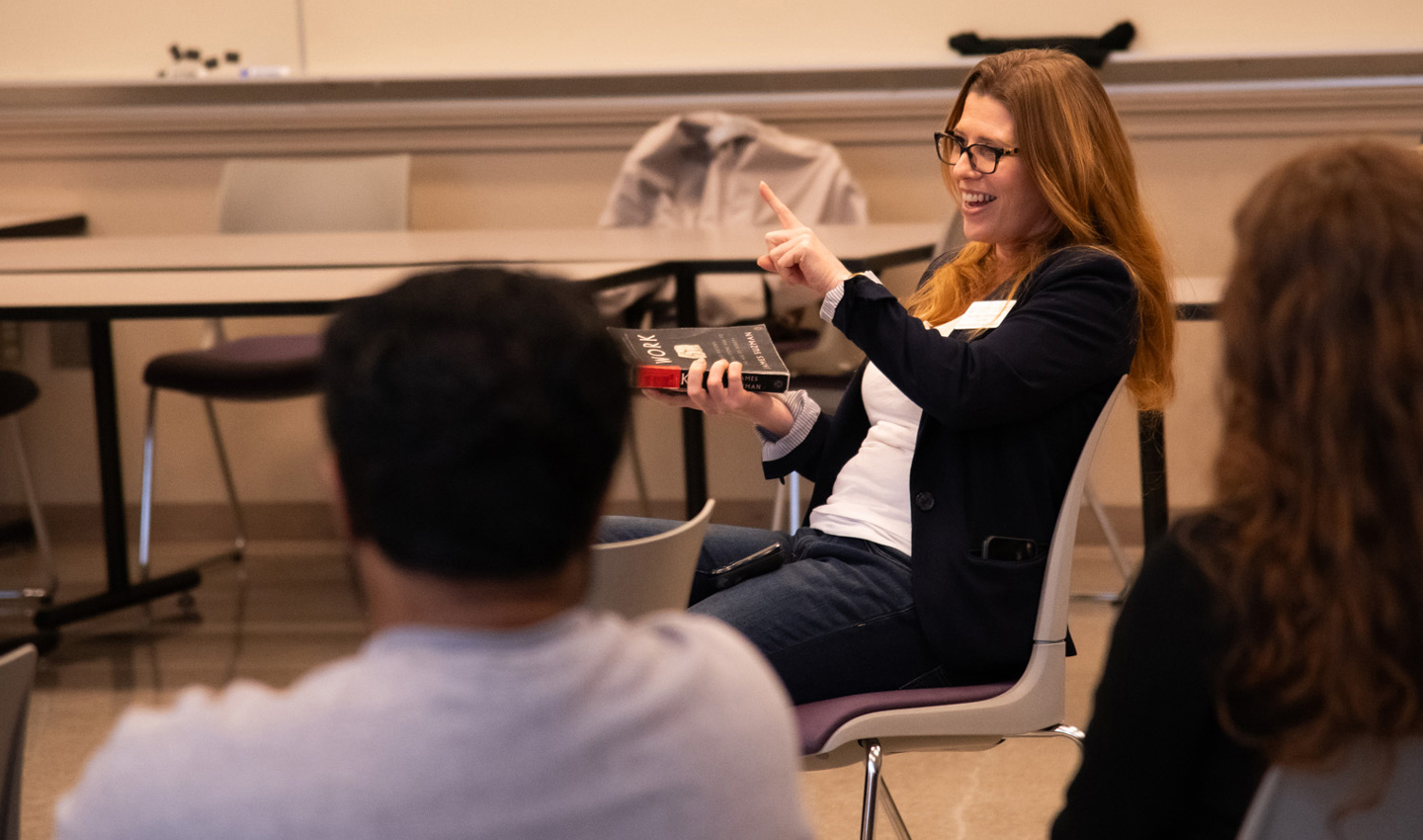
But the field of people analytics can provide managers with the tools they need to better understand their hiring practices and workforce. And few people understand the subject better than Heather Whiteman, an associate teaching professor for the University of Washington Information School.
“Many people have never heard of people analytics outside of human resources,” said Whiteman, whose expertise won her recognition as a global influencer in the People Analytics Network Census last year.
The discipline dates back decades but was popularized in the 2010s, she said. As a practitioner, Whiteman has held vice president and executive-level roles and has worked as a consultant and researcher. She’s helped integrate people analytics curriculum in eight universities across three continents, including multiple stays as a Fulbright Scholar in Guatemala. She found her academic home in the UW’s Information School.
Organizations can use people analytics to help predict how many employees will leave in the next year or to identify breakdowns in communications amongst employees.
People analytics also can identify “the hidden ways work gets done,” Whiteman said. “Who do people really go to to get work done? Who do they really listen to?”
Given that 80 percent or more of an organization’s value comes from its employees, Whiteman said, it’s imperative that managers have data that tells them how their workforce operates and what their employees need to remain at the organization.
Despite the need for the information that people analytics can provide, the subject isn’t often taught.
“University-level people analytics courses are still pretty rare,” Whiteman said.
The waiting list to take her course fills up the first day it is available. Whiteman notes that many of her students initially say they aren’t interested in analytics. However, they change their minds when they realize what they can do with people analytics and how it can be used to help others.
Many students who take Whiteman’s class go on to work on people analytics as part of their Capstone projects. “People really love that blend of data and people,” Whiteman said. “The work really resonates.”
Maisie Liu, a student in the Master of Science in Information Management program, chose to take the class because she was familiar with Whiteman, not the subject matter.
“I really didn’t have any idea of what the class was about,” Liu said. “I realized pretty quickly it was a pretty cool field.”
Liu recalled an assignment in which students analyzed employee communications and networking for a company. The exercise revealed which employees are isolated from the rest of the group. And “we got to see who the influencer in the group is,” Liu said.
Liu noted that companies can learn a lot during onboarding and in exit surveys. A lot of companies focus on the compensation that they offer. Through people analytics, Liu realized that business culture is sometimes as important to employees as their compensation.
For their final project, students assessed a company that has remote workers and has managers who are concerned about employee burnout. The students were asked to devise recommendations for the company based on data.
“Students get super passionate and make up their own dashboard,” Whiteman said.
One of those super passionate students is Sarayah Obonyo, who chose to take the class because she had already taken another of Whiteman’s classes.
“I love it. I think it is the most challenging class I’ve ever taken,” she said. “It really bends and stretches my brain.”
For the project looking at remote work, Obonyo noted, “You think that remote workers experience less burnout because they have more flexibility and autonomy. But people still burn out.” One of the main reasons, Obonyo said, is constant communication through Slack, email, and other channels. People analytics provides a tool for understanding employee grievances as well as what managers can do to address them. “It’s all backed by data,” Obonyo said.
Obonyo is so intrigued by people analytics that she’s considering how to incorporate it into her career.
“I would absolutely do this as a career,” Obonyo said.
Students who want to include people analytics in their career paths could consider human resources-related jobs such as people data scientists or people analysts, Whiteman said. People analytics is useful in business, psychology or any organization with human resources. “Information management grads are perfect for those jobs,” she said.
MSIM student Buka Berk is looking for a career as a project or product manager. He thinks he’ll be able to apply people analytics to identify skills gaps on his teams. “It’s a very specific field, but the skills are applicable to almost anything,” he said.
People analytics is “a great opportunity to intersect people, technology and business practices,” Berk said. “It’s a great foundation.”
Berk lauds Whiteman’s teaching ability, mentioning he especially appreciates her discussion of ethics in data.
“People analytics is all about collecting employee data and helping employers retain people,” Berk said. In Whiteman’s class, students discuss which sources of data could be biased and how much personal data they should be collecting.
Whiteman does a great job of providing tools for students, Berk said.
“She’s a great teacher, super optimistic. She’s able to get a lot of participation,” he said.
Obonyo agreed, calling Whiteman’s teaching abilities amazing.
“She knows what she’s doing,” she said.