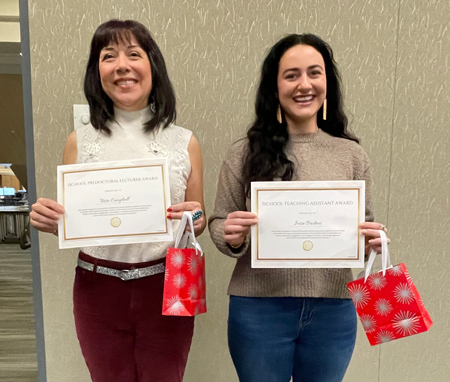
Teaching assistants Jesse Brisbois and Tessa Rose Campbell were recently recognized for the impact they’ve made in the classroom. Through the TA and Pre-Doctoral Lectureship Awards, the University of Washington Information School honors TAs who strive for excellence.
Advised by iSchool Associate Professor Clarita Lefthand-Begay, Brisbois is a fourth-year student in the Ph.D. program. She received the TA Award.
As a TA for INFO 300 Research Methods, Brisbois said she found many benefits of teaching a research course.
“When I started teaching, I was not confident in statistics or quantitative methodologies,” Brisbois explained. “But when you’re teaching a Research Methods course, you have to learn statistics; you have to learn it to the point where you can explain it.”
Brisbois shared that by grading her students’ work, she was able to find the same mistakes in her own research. “It’s so cliche,” she said, “but everybody is learning from each other.”
Recalling the first section she taught, Brisbois said she was incredibly nervous. However, her apprehension was quickly replaced with appreciation. “I truly loved it,” Brisbois said.
When she entered the Ph.D. program, she had her heart set on solely research. But, as she taught, her priorities began to shift. “When I graduate, teaching might be something that I want to do, which I never thought would be the case,” she said.
Brisbois’ research is focused on uranium exposure in the Spokane Tribe from the Midnite Mine, an inactive uranium mine that operated during the Cold War. A descendant of the tribe herself, she was concerned with the number of tribal members who have died of cancer due to the exposure. She made it her mission to find methods of intervention that will bring relief to Indigenous families.
Like Brisbois, Campbell’s research also revolves around her tribe. Campbell is investigating how the Tulalip Tribes find, utilize or avoid information concerning food sovereignty in order to take action against diabetes. Campbell received the Pre-Doctoral Lectureship Award.
She began her education at the iSchool in 2005 when she applied to the Master of Library and Information Science program. After graduating in 2008, she thought she had settled into her career at the Tulalip reservation’s Hibulb Cultural Center as a curator.
However, Campbell enrolled in the Ph.D. program during the pandemic after her current faculty advisor Miranda Belarde-Lewis and iSchool Professor Emeritus Cheryl Metoyer encouraged her to apply.
Her experience at Hibulb helped her transition to the college classroom. “My teaching philosophy was derivative of when I worked for my Cultural Center,” Campbell explained.
While teaching for INFO 353 Indigenous Ways of Knowing in the Digital Age, Campbell was able to incorporate community participation into the course, a skill she developed at Hibulb. She lectured on how the Tulalip Tribes are currently utilizing technology in government and creative practices and invited three tribal community members to guest speak in the class.
Along with her tribal community involvement, Campbell’s pedagogy is also influenced by Lefthand-Begay’s “guiding principles.” Campbell describes the principles as foundations for a classroom environment where students feel comfortable participating and interacting with each other.
By being a predoctoral lecturer, Campbell said she’s been able to build relationships with students and subsequently developed a deeper understanding of students’ academic needs.
“I think it’s important if you want to go into academia, to definitely be a TA,” Campbell said. “It’s been such an amazing learning process for me, and for my personal and academic development.”
She also noted that by being a TA, she was exposed to a variety of course subjects, expanding her knowledge in all domains.
“The knowledge gained is so invaluable,” Campbell said.